Tuesday, 17 April 2012

Paper piecing for little toes

Drawing out diamonds onto freezer paper
Am loving doing my first paper pieced quilt, a baby one mind!  I have long been inspired by Lucy Boston's work, and the sorrowful memory of giving up on a Grandmother's Flower Garden piece when I was younger. I pleasantly agonised over my choice of fabrics for Evie's quilt, it gave me the perfect excuse to browse and buy at the trader's hall at the Quilters' Guild AGM in Dundee.  I'm glad I took the time, I'm very happy with the soft eastery yellow and bright yet not too bright fabrics that go with it.  The orange is actually left over from Isabel's quilt but goes just perfectly.  My plan is to eventually make a larger quilt with smaller patches for myself / the house from my box of hoarded scraps and daughter's outgrown clothes, a memory quilt in the style of Tolly's grandmother in Lucy Boston's The Chimneys of Green Knowe.

I'm using freezer paper for my patches.  Personally I've found it far and away the best thing to use for paper piecing because it sticks to the back of the fabric when ironed on and so stays neatly in place while you're tacking the patch down.

First trial of pieces
How to create my templates took me a while to figure out, messing around with printers, but far and away the most economical way to use the freezer paper to get the maximum number of templates was to draw them out myself.  Cue some work with 60 and 120 degree angles and a soothing time spent cutting out templates, and some questions as to how a parallel line can 'move'.

I ironed a few paper pieces on to my fabrics making sure they were at least half an inch apart, then cut them out giving myself at least a quarter of an inch all round to turn over.  Once I'd tacked a few I laid them out to get an idea of how many I was going to need, and then I worked out all the fiddly half hexagons and half and quarter diamonds I was going to need for the edges.  
Final design
I always knew the design was going to be stars and hexagons, but I didn't know how I was going to assemble the diamonds into stars and how big the stars and hexagons were going to come out.  I had thought random would be fine, but then looking at it decided on expanding concentric 'circles' of each kind of star and to match the orange with the green and the blue with the white.  The green stripe was slightly fussy cut in that I decided to keep the stripes lengthways, but this was the direction of the weave.

I broke out the isometric paper and drew out what I had already (coloured in shapes, left).  To keep the pattern right I worked it out beyond the edges of the quilt (unfilled shapes, left) and could then just count how many setting edge pieces I was going to need of each colour.  I had to make the white patches black because my brain just couldn't cope with remembering which ones should be white!

Paper piecing is the ultimate take along sewing, the tacking was done on the train to and from Stirling, and even kept me occupied on a cold Perth station platform as the snow came down.   Piecing is now taking place in front of the tv under a duvet as the Scottish 'spring' flexes its claws, and it's growing fast.  All I have to figure out now is how to bind the quilt and back it.  I'm thinking knife edge binding, it will be a new thing for me, I've always done continuous binding before.  And I might just do tied / knotted quilting rather than continuous.  No more babies please!

Book making - a whole new world

Folded paper pocket books
I write a diary on a daily basis and have always felt a little dissatisfied, I stick into the pages articles that I read but writing in a bound diary has limitations.  I would like to be able to include more, in addition to the fabrics, wool, threads and small pictures I include I would like to be able to just add in a knitting pattern page rather than having to copy it out or have it reduced so small it cannot be reproduced.  I am fascinated by art journalling and, as you can tell, I blog, but I need a way to bring it together.

On the last weekend of March, the last days of the beautiful warm weather before the snow swept in, I biked to Arbroath to Fran Marquis' house and studio, Springfield Creative Arts Centre.   I nervously made my way in but was quickly made to feel at home by Fran and our bookmaking tutor for the weekend, Kirsty O'Connor.   Fran's house is just beautiful and I wanted to have everything in sight!  The studio room has a high ceiling and is perfect for use as a studio, full of light and space.

I spent the first day reliving all the best aspects of doing art when I was younger, creating papers and cards for our books using paint, paper paste and stamping, getting thoroughly messy and really enjoying myself.  We broke both days for a delicious lunch provided by Fran, even able to put up with my gluten free diet.  On the Sunday we created folded books out of our papers and Kirsty showed us all her tips to create the kind of professional finish I didn't think I was capable of.

Kirsty will be coming back in September and I am so there!  This time we'll be doing stitched books, and this returns me to my first paragraph.  If I can learn how to make books, I can journal on a day to day basis and bind the result, either on a year basis or divide it up if that's too big.  I can write on writing paper and just include in and cut down everything else to size, sketches, articles printed off from online.  I can use the teeny envelopes you get to hold ephemera such as travel and cinema tickets, little things that are so evocative.

Friday, 30 March 2012

New Makower London fabrics

Although we live in Scotland, my mum lives in Cambridge and since Caitlin was young we've gone on many happy day trips to London.  On our most recent trip we took the Docklands Light Railway through to Greenwich thorough the surreal Canary Wharf and walked back under the river along the tunnel, and visited Trafalgar Square to climb on the lions.  As she'd just finished a school project on Egypt we visited the mummies, statues and Rosetta Stone at the British Museum and took the tube to Embankment to see Cleopatra's Needle.  She adores London, and I can't wait to buy her these new Makower fabrics released to celebrate our capital city in the Olympic and Jubilee year.  Not sure what we will do with them yet, but as soon as they're back in stock I'll get these  three for her and I'm sure there will be a project to follow.

Thursday, 29 March 2012

Around The World - Quilters' Guild AGM Dundee 2012

This is my 8 year old daughter Caitlin's Australian quilt which she had been working on since Christmas, her answer to the theme of 'Around the World' inspired by a school project on the country and my fabrics brought at my very first Festival on Quilts in Birmingham from Aussie Dreams, these make up most of the territories of Australia on the top right panel and the various animals and Uluru in the bottom left panel.

The rest of the fabric was all bought at the 2011 Knitting and Stitching show in Harrogate, the bottom right was a Langa Lapu sun print from The African Fabric Shop.  They are a long time favourite of myself, my daughter and my mother, the owners, Magie and Bob, travel around Africa to source their fabrics directly from the weavers and dyers and each piece is unique.

For the first two panels, Caitlin sewed strips of fabric together then cross cut them to make the backgrounds of squares, using the sizes to give the effect of zooming in from outer space.  In the first panel she appliqued on Australia, New Zealand, Antartica and Indonesia and then appliqued the whole globe onto the dark spacey background.  In the second she used 505 spray to stick the Aussie Dreams fabrics down and appliqued them onto the squares background with a space dyed WonderFil thread she bought at her Quilters Guild Region 16 Regional Day.

In the third panel the sky, land and billabong were strips of fabric sewn together, then all the animals and the rock were appliqued on.  The sun and Uluru are reverse appliqued.

The koala and kangaroo joey were the successful product of my first foray into printing onto fabric with my laser printer with Crafty Computer Paper, who I've used before for inkjet printable fabric.  I printed onto their laser heat transfer paper and we carefully ironed the animals onto white fabric.  I was so nervous because the paper is not cheap, but the results were stunning.  Caitlin then used my Derwent Inktense pencils to colour in the kangaroo joey and a little bit of the koala joey, they are quite grey anyway, and then appliqued them on.

You can't see it, but the quilt is backed with the most fabulous green liquorice allsorts fabric.  Caitlin quilted in the ditch round each panel and also quilted a couple of stars with invisible thread.  She sewed on the binding, which is from the Very Hungry Caterpillar range by Makower, and I slip stitched it in place.  I found basting with 505 spray easy and it held the sandwich of quilt top, backing and 80/20 backing in place perfectly while she was machine quilting.

The borders are strips pieced in turn, and there is a kangaroo button from The Button Lady sewn onto the central square.

It can be difficult to fit the time and mental energy needed to focus on sewing inbetween the busy day to day life of an 8 year old and I was very proud of her hard work.  She created really all of this, designing and executing the whole thing with me acting as faciliator more than anything else, holding down the ruler for rotary cutting, paying for fabric, being an extra pair of hands and providing support if needed, moral and practical!  She won her class in the YQ competition for the Quilters' Guild AGM in Dundee and I freely admit to being a very proud mum!

Wednesday, 28 March 2012

McManus Archive Visit - Quilters' Guild AGM 2012

On 23 March I made my way eagerly to Dundee's Barrack Street museum, once the holder of the zoology collection of the McManus Galleries, now the home of the curatorial staff.  We were going to see quilts selected for us by members of the Quilters' Guild.  We were escorted into a beautiful room lit from above by a central circular skylight that allowed us to see the quilts in a way that artificial light cannot match.  Quits were spread across tables all over the room and the curatorial staff took us through what they knew about each piece.  I've just included three here, the ones for which they had the most information.  To be able to see these pieces up close was a real treat.

Whaler Quilt 1880-1890
Quilt showing reverse side at right
This quilt was made by Mr Nicholas White, a whaler born in 1853 in Cork.  He served on The Balaena  as a steward and harpoonist, one of six men in a small wooden boat who would harpoon the whale and bring it back to the ship for processing.  He was married to Margaret and had two children.

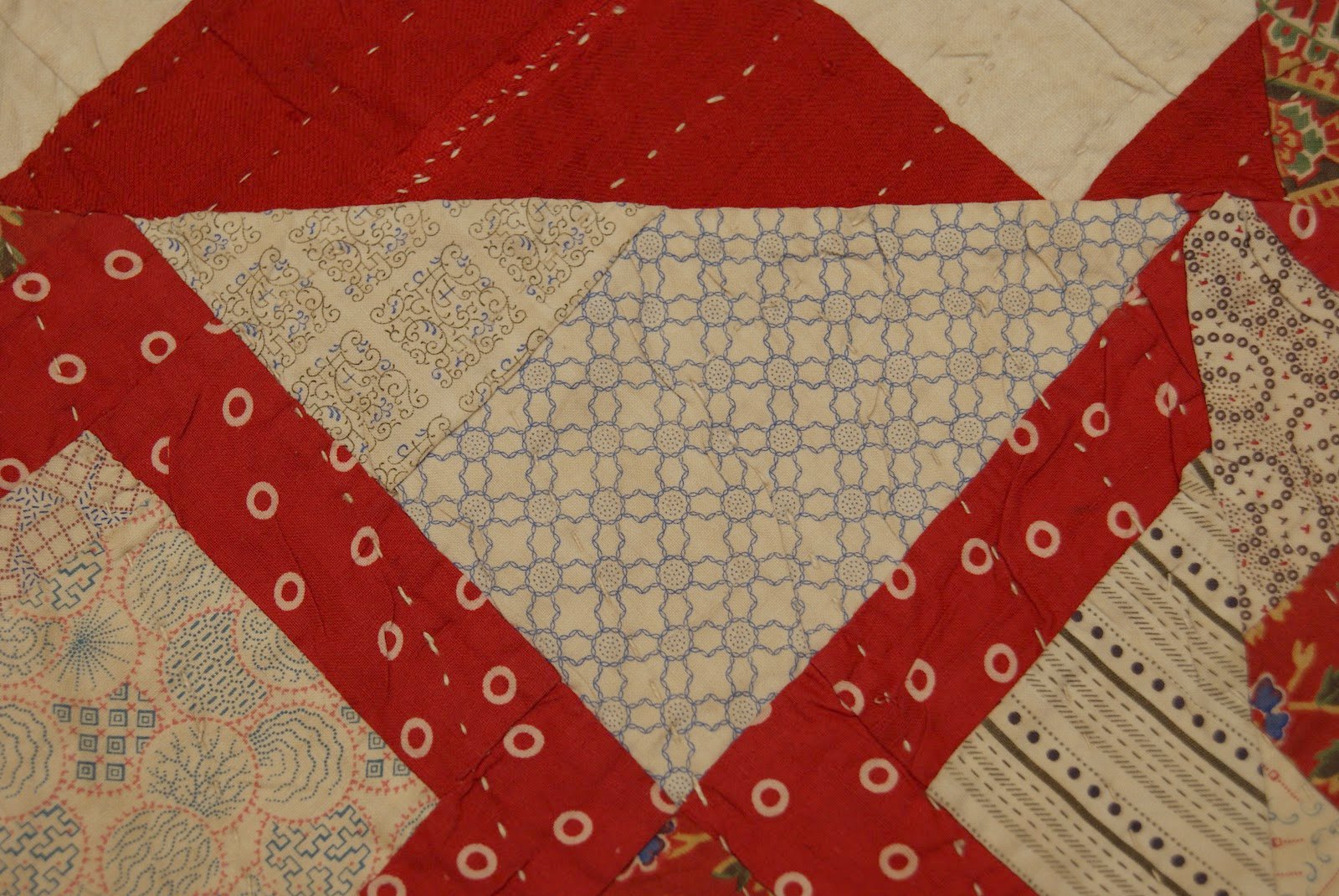
The chevron pattern on the quilt is similar to those found on the northwest coast of England, on the Isle of Man and in Northern Ireland.  The turkey red fabrics would have come from the Vale of Leven near Glasgow, one of the first places in the UK able to produce the fabric because of the quality of its water.  Turkey red dyeing came over from France who were the first Europeans to produce it, but the fabric had been brought in by traders since the 17th century.  Turkey red and associated discharge prints were very popular as it was the first red dye that did not fade or bleed.

Contrast fabrics, blocks were patched together
The other fabrics in the quilt could be from a sampler book that Mr White took to sea with him, or perhaps from shirting.  It was created on board ship as a way to pass the time on the long journey to the Southern Ocean.  The quilt is in two layers  and the edges are butted which indicates it is English or Irish, as opposed to the American tradition of binding.

The quilt was donated by Mr White's nephew.

Paper pieced hexagons tablecloth circa 1840
Front showing delicate stars created from pieced hexagons
Tablecloth made of silk, velvet, brocade and ribbon.  Made by Anne Loney, her husband was gardener at Fingask Castle and the fabrics are believed to have come from the household.  The matching tea cosy is on permanent display at the McManus Galleries, and this quilt is featured in Janet Rae's book Quilts of the British Isles.  The border is precisely worked out on five sides, but on the sixth it is completely disorganised.  The hexagons are pieced with string over what appears to be scrim but there are no paper pieces, it may have been stiffened and used in place of papers, or it may have been used to back and stiffen them.

The story of this quilt reminds me of Lucy Boston's book The Chimneys of Green Knowe.  In it Tolly sits by the fire with his grandmother while she mends old patchwork quilts made of paper pieced hexagons just like this tablecloth, and she tells him the story of the pieces of fabric which have come from Green Knowe when it was a much grander house.  There is evidence of designing, of fussy cutting of hexagons and careful placing but also of making do, of running out of fabrics.  On the reverse the rainbow coloured edgings of ribbons are clearly visible, it must have been slippery stuff to sew!

Prohibitionist Party Banner 1904
This banner was created as a fund raiser for the Scottish Prohibitionist Party.  Party members would have paid to have their names embroidered on the diamonds and the banner would have been used at their meetings.  Names on the banner include Walter Walsh, chairman and radical minister of the Gilfillan Memorial Church, and Edwin Scrymgeour, organising secretary.  The banner was created at an important moment in the history of the Scottish Prohibitionist Party, in 1903 there was 1 branch which expanded to 3 in 1904.  The banner was donated to the McManus in the 1970s and its remarkable condition is due to it being kept away from light.

Wednesday, 15 February 2012

Caitlin's gloves

Caitlin bought this lovely glittery wool for herself a while ago, it's Creative Yarns DK Rainbow Glitz in Red/Black.  She wanted a pair of gloves, due largely to her ability to lose them, and I'd just got myself Susette Palmer's book Gloves.

These gloves are quite simple, they are simply a twin of each other with no extra rows after the little finger, and way too big for her despite me doing a tension swatch, but she loves them and that's all that matters.  It was nice to get back into circular knitting again, I enjoy making gloves and once I've finished the aran tunic I'm on I'm planning to use the leftover wool to make myself another pair, I just have a pair of long armed gauntlets at the moment since I lost my flipover fingerless gloves.

Tuesday, 17 January 2012

Lap blanket

Morag's Lap Blanket
My mother in law needed something special for Christmas, not least because her birthday and Christmas day are one and the same.  I wanted something to keep telling her how loved she is when she goes into hospital, and as she has become more ill she gets increasingly cold.  I may not be able to wrap her up and protect her, but I can give her something which does.  So, a month before Christmas resting on my laurels with all the lap quilts done, I launched into knitting squares from Debbie Abraham's inspirational book Blankets and Throws to Knit.  I had meant to do something colourful for our house, but this was more important.

I knitted and knitted til my fingers were sore, and once I had 8 squares washed them and pinned them out carefully onto a polystyrene fish box lid (clean I'll have you know) on which I'd drawn squares of the right size, 7 inches I think.  It was amazing the shapes these 'squares' came out as, both when I was knitting them and after washing!  I thought I'd done enough, but then laid them out and realised I had nowhere near enough, cue more knitting!  Some of the squares have beads knitted into them, which involved at times sitting patiently with a bead reamer and enlarging the too small holes on the 4mm beads I had.  I learned intarsia knitting and how to use circular needles, and Scott sewed the squares together.  Then we frantically cut and threaded through endless eight inch lengths of wool for the tassels, finishing with a sigh of relief on Christmas Eve, and completely contented with our efforts.  Not necessarily elegant, but bright and cheerful, the intended effect.