On 23 March I made my way eagerly to Dundee's Barrack Street museum, once the holder of the zoology collection of the
McManus Galleries, now the home of the curatorial staff. We were going to see quilts selected for us by members of the Quilters' Guild. We were escorted into a beautiful room lit from above by a central circular skylight that allowed us to see the quilts in a way that artificial light cannot match. Quits were spread across tables all over the room and the curatorial staff took us through what they knew about each piece. I've just included three here, the ones for which they had the most information. To be able to see these pieces up close was a real treat.
Whaler Quilt 1880-1890
 |
| Quilt showing reverse side at right |
This quilt was made by Mr Nicholas White, a whaler born in 1853 in Cork. He served on
The Balaena as a steward and harpoonist, one of six men in a small wooden boat who would harpoon the whale and bring it back to the ship for processing. He was married to Margaret and had two children.
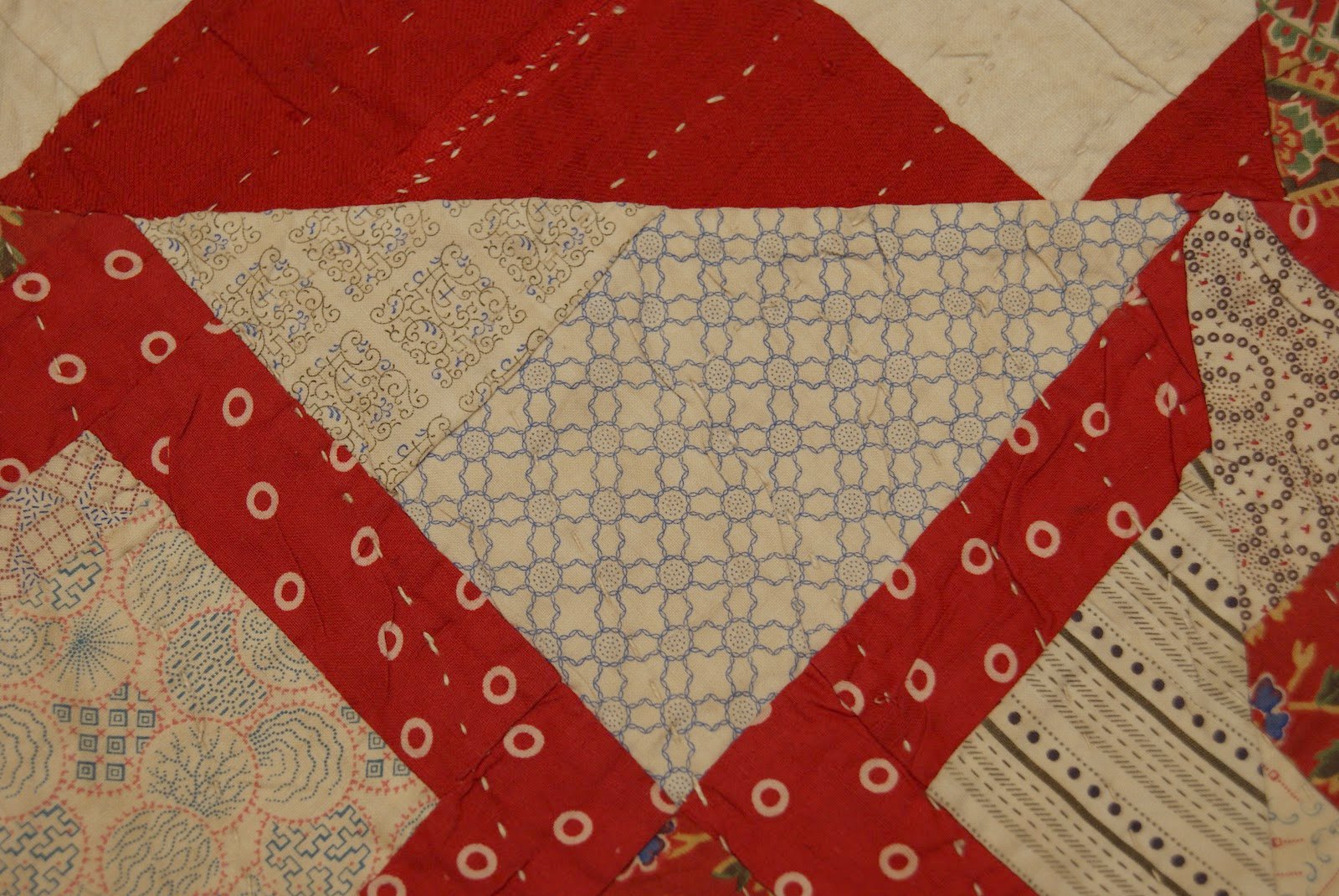
The chevron pattern on the quilt is similar to those found on the northwest coast of England, on the Isle of Man and in Northern Ireland. The turkey red fabrics would have come from the Vale of Leven near Glasgow, one of the first places in the UK able to produce the fabric because of the quality of its water. Turkey red dyeing came over from France who were the first Europeans to produce it, but the fabric had been brought in by traders since the 17th century. Turkey red and associated discharge prints were very popular as it was the first red dye that did not fade or bleed.
 |
| Contrast fabrics, blocks were patched together |
The other fabrics in the quilt could be from a sampler book that Mr White took to sea with him, or perhaps from shirting. It was created on board ship as a way to pass the time on the long journey to the Southern Ocean. The quilt is in two layers and the edges are butted which indicates it is English or Irish, as opposed to the American tradition of binding.
The quilt was donated by Mr White's nephew.
Paper pieced hexagons tablecloth circa 1840
 |
| Front showing delicate stars created from pieced hexagons |
Tablecloth made of silk, velvet, brocade and ribbon. Made by Anne Loney, her husband was gardener at
Fingask Castle and the fabrics are believed to have come from the household. The matching tea cosy is on permanent display at the McManus Galleries, and this quilt is featured in Janet Rae's book
Quilts of the British Isles. The border is precisely worked out on five sides, but on the sixth it is completely disorganised. The hexagons are pieced with string over what appears to be scrim but there are no paper pieces, it may have been stiffened and used in place of papers, or it may have been used to back and stiffen them.
The story of this quilt reminds me of Lucy Boston's book
The Chimneys of Green Knowe. In it Tolly sits by the fire with his grandmother while she mends old patchwork quilts made of paper pieced hexagons just like this tablecloth, and she tells him the story of the pieces of fabric which have come from Green Knowe when it was a much grander house. There is evidence of designing, of fussy cutting of hexagons and careful placing but also of making do, of running out of fabrics. On the reverse the rainbow coloured edgings of ribbons are clearly visible, it must have been slippery stuff to sew!
Prohibitionist Party Banner 1904
This banner was created as a fund raiser for the Scottish Prohibitionist Party. Party members would have paid to have their names embroidered on the diamonds and the banner would have been used at their meetings. Names on the banner include Walter Walsh, chairman and radical minister of the Gilfillan Memorial Church, and Edwin Scrymgeour, organising secretary. The banner was created at an important moment in the history of the Scottish Prohibitionist Party, in 1903 there was 1 branch which expanded to 3 in 1904. The banner was donated to the McManus in the 1970s and its remarkable condition is due to it being kept away from light.